
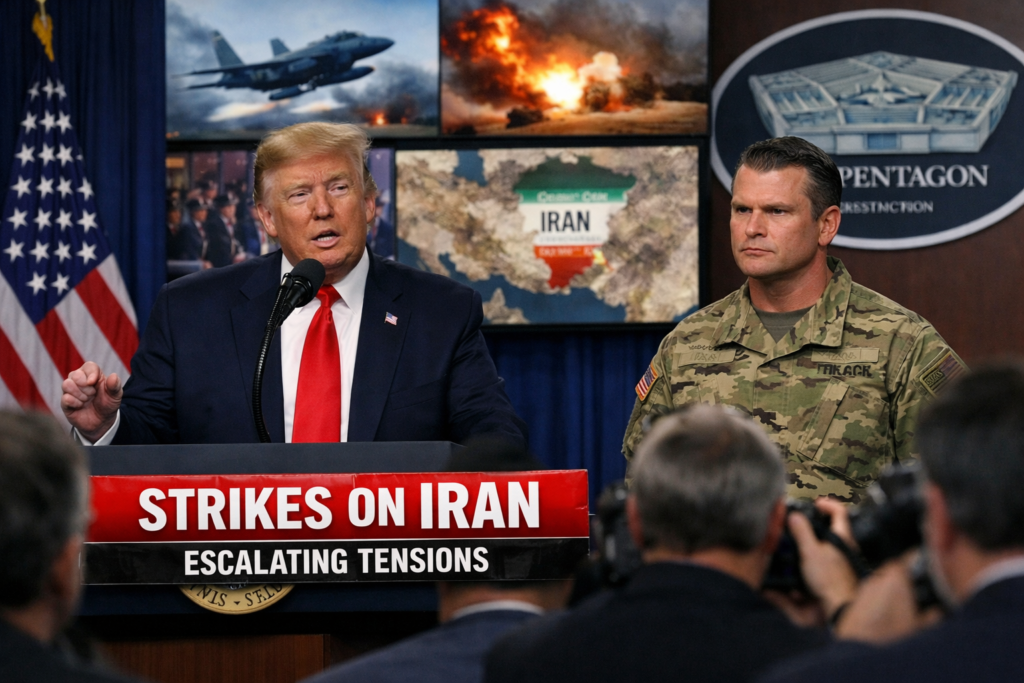

Washington, DC — As American and Israeli forces intensify military operations targeting Iran, the administration of President Donald Trump has presented varying explanations for the escalation, framing the action as both a response to urgent security risks and a strategy to counter what it describes as a long-term nuclear and ballistic missile threat.
On Monday, President Trump and Defense Secretary Pete Hegseth emphasized that Iran’s regional activities since the 1979 Islamic Revolution, combined with the development of its missile capabilities and nuclear ambitions, pose what they consider a direct and immediate danger to U.S. interests.
Secretary of State Marco Rubio offered an additional perspective, stating that Israel had been preparing independent military action against Iran. According to Rubio, U.S. officials believed that Iranian retaliation could have targeted American personnel and facilities in the region, leading Washington to launch what it described as a preemptive response.
However, critics argue that the administration has not publicly provided substantial evidence to support claims of an imminent threat. Several analysts, advocacy groups, and Democratic lawmakers — including those who attended classified briefings — have questioned whether the intelligence presented justifies the scale of military engagement.
Emma Belcher, president of the nuclear policy organization Ploughshares, stated that the lack of publicly available evidence raises concerns about transparency and accountability. She suggested that insufficient disclosure may indicate either confidence that public approval is unnecessary or uncertainty about the strength of the underlying intelligence.
While Republican lawmakers have largely supported the administration’s position, Democrats have signaled plans to pursue votes on war powers legislation, seeking to reinforce Congress’s constitutional authority over military action.

The debate continues as tensions rise across the region, with global leaders closely monitoring developments that could significantly reshape Middle East security dynamics.